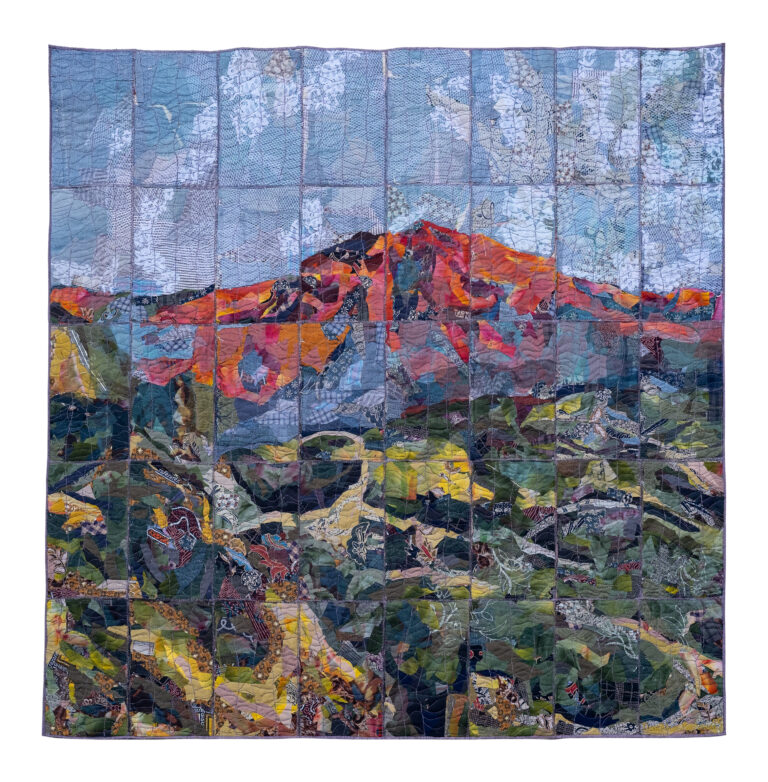
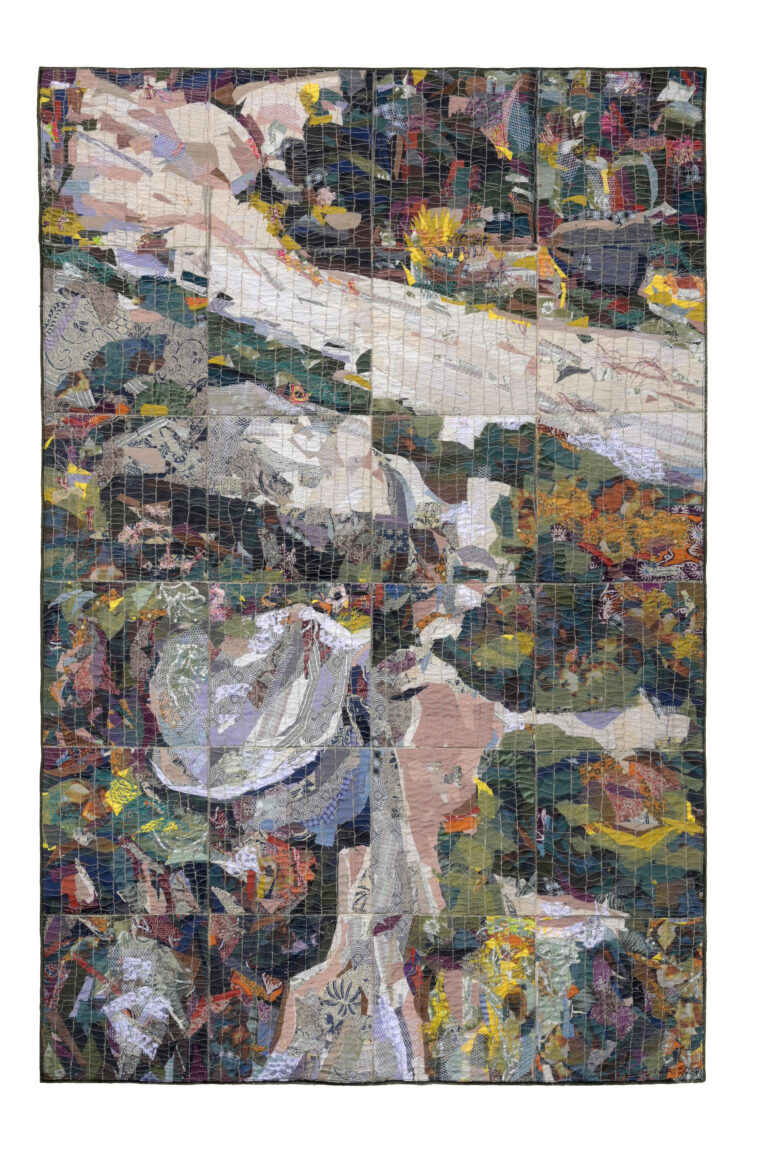
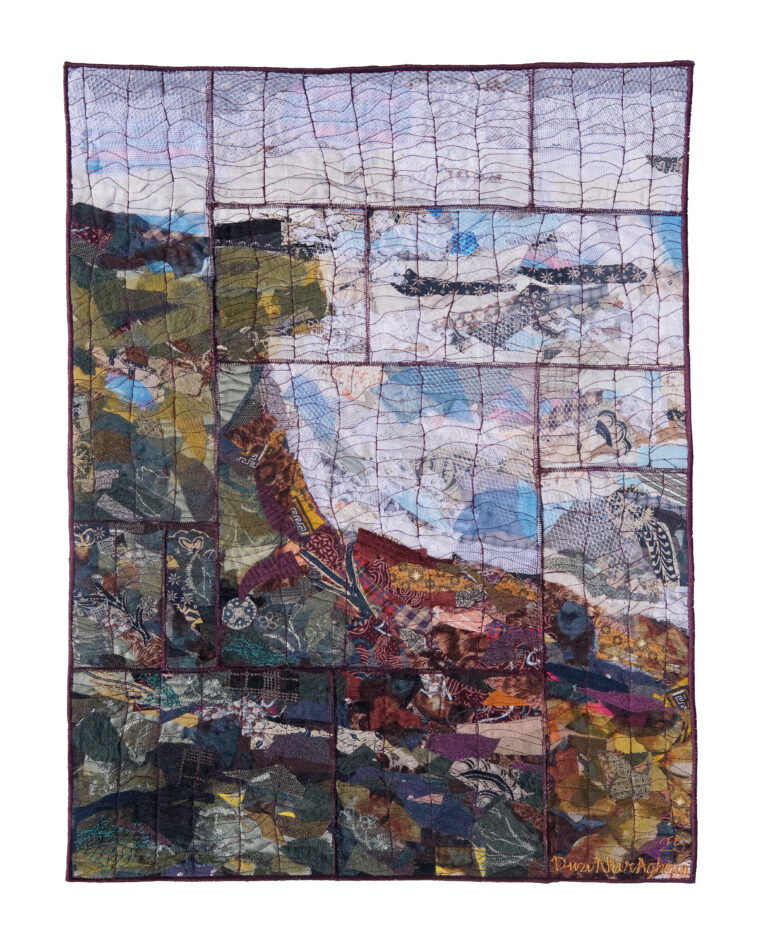
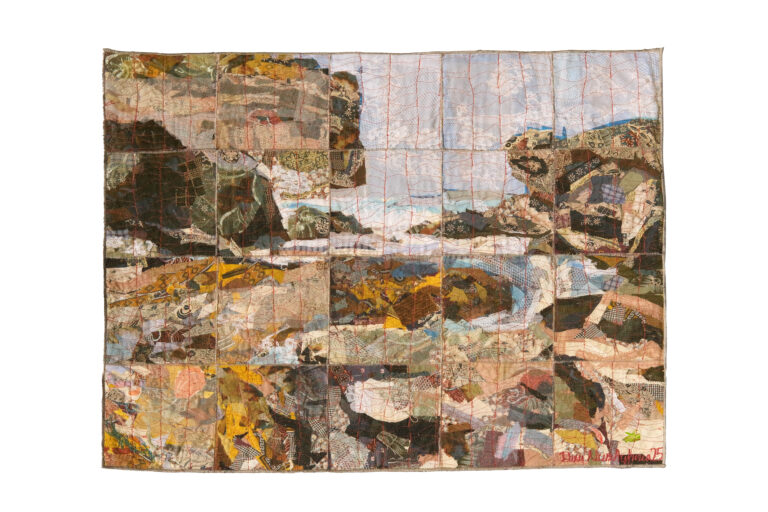
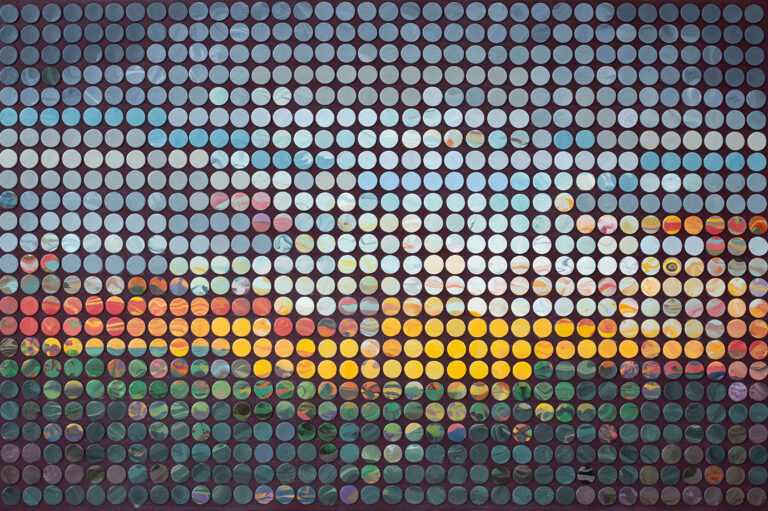
Indonesian artist Dini Nur Aghnia presents her latest solo exhibition, What Gathers, What Holds, at Gajah Gallery Yogyakarta, opening 25 April 2026, in close proximity to the commemoration of Kartini’s Day. The exhibition introduces a new body of work that approaches Landscape through a materially-driven inquiry, combining clay, resin, and patchwork textiles into layered compositions that unfold across strata. Aghnia moves through fragments; landscape, no longer a totalised vista, becomes proximal—formations made through constant, accumulative change.
Presented within the cultural moment of Kartini’s Day, which honors the legacy of Raden Ajeng Kartini and her advocacy for Indonesian women’s agency and expression, Aghnia’s practice resonates through its material choices and processes. Stitching, long associated with domestic and female-centered labor, is here rearticulated as both method and language. Through patchwork, she does not merely assemble fragments but asserts a form of authorship—one that remains attentive to care, repetition, and continuity while still insisting on new ways of seeing and constructing landscape.
Unlike traditions of Landscape painting in Indonesian art history, such as Mooi Indie, where nature was often aestheticised through a colonial optic, Aghnia’s work proposes an alternative reading that gives rise to new ideas of Landscape. The landscape here is not external to its subject, rather emerging through relation: between body and environment, memory and material, perception and lived experience. What is seen is inseparable from how it is held.
Her works refuse composition; they accumulate. Coordinates of clay and resin are assembled with near-pixelated precision, while fragments of fabric are stitched and reconfigured using patchwork. At a distance, these surfaces cohere into images of mountains, seas, or forests; in proximity, they disperse into discrete yet interdependent elements. Representation gives way to relation where landscape is produced through encounter, not depiction. Embedded within these works are traces of the artist’s personal experiences. Clay is pressed, fabric is stitched—gestures that register as both repetitive and restorative. Memory does not resolve into image; it accumulates like sediment into form. Each work becomes a site where time is neither fixed nor linear, but layered and felt.
The title, What Gathers, What Holds, reflects an ongoing process of collecting and sustaining temporal fragments. Small objects are encased in resin, preserved and suspended; textiles are pieced together in gestures that suggest care and continuation. Here, holding is both a physical act and a conceptual proposition: a way of attending to what might otherwise remain dispersed or unarticulated.
Resisting the fixity of photorealism, Aghnia draws the viewer into an unstable realm—where Landscape is not fully graspable, but continuously forming. Viewed in this context, What Gathers, What Holds situates her practice within a broader contemporary discourse on relational materiality, while also opening a subtle dialogue with histories of women’s labor and expression in Indonesia, marking a significant contribution to evolving conversations around Southeast Asian art.